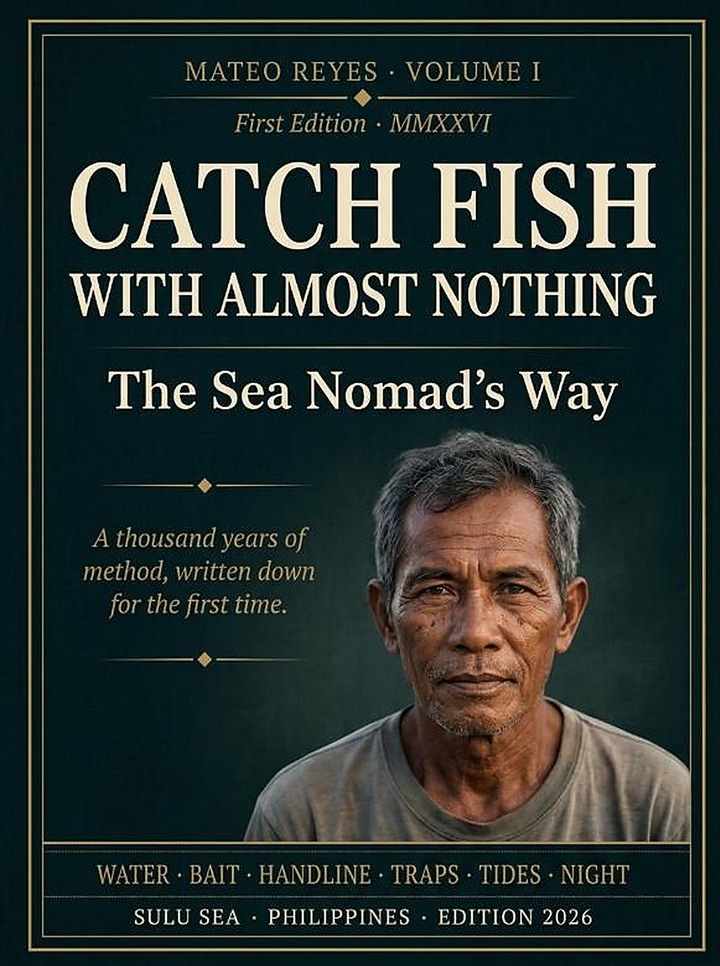
A thousand years of catching fish with almost nothing — written down for the first time.
My people have never owned a fish finder. We have never owned a $400 rod. We were born on boats, and for a thousand years the sea either fed us or it did not — so nothing in our method was ever allowed to be wrong. This is that method. All of it. On paper.
The Bajau have lived on the water since before your country had a name. No shops. No engines. No electronics. When a Bajau man could not read the water, his family did not eat that night — so every method we kept had to work, every time, with nothing.
Today the young ones leave for the towns. My grandfather's generation is almost gone, and they wrote nothing down, because among us nothing was ever written down. It was put in your hands and you repeated it back until you had it right. When the last of them go, it goes with them.
"A tackle shop sells you a thing. My grandfather gave me a way of seeing. The thing runs out, breaks, or gets left in the truck. The way of seeing never does." — Mateo Reyes
On the water without a single tool you can buy. Everything in this book predates the tackle industry by roughly nine centuries.
Spent per year on gear by the average recreational angler. My grandfather spent nothing and came home heavier.
The feeding window most men sleep through. We do not fish all day. We fish the hours the water tells us to.
Boats required. Every method here works from a shore, a bank, a pier, or standing waist-deep in the water.
I am Mateo Reyes. I was born on a lepa off Tawi-Tawi and I have fished the Sulu Sea my whole life. None of what is in this book came from me being clever. It came from a thousand years of my people going hungry when they got it wrong.
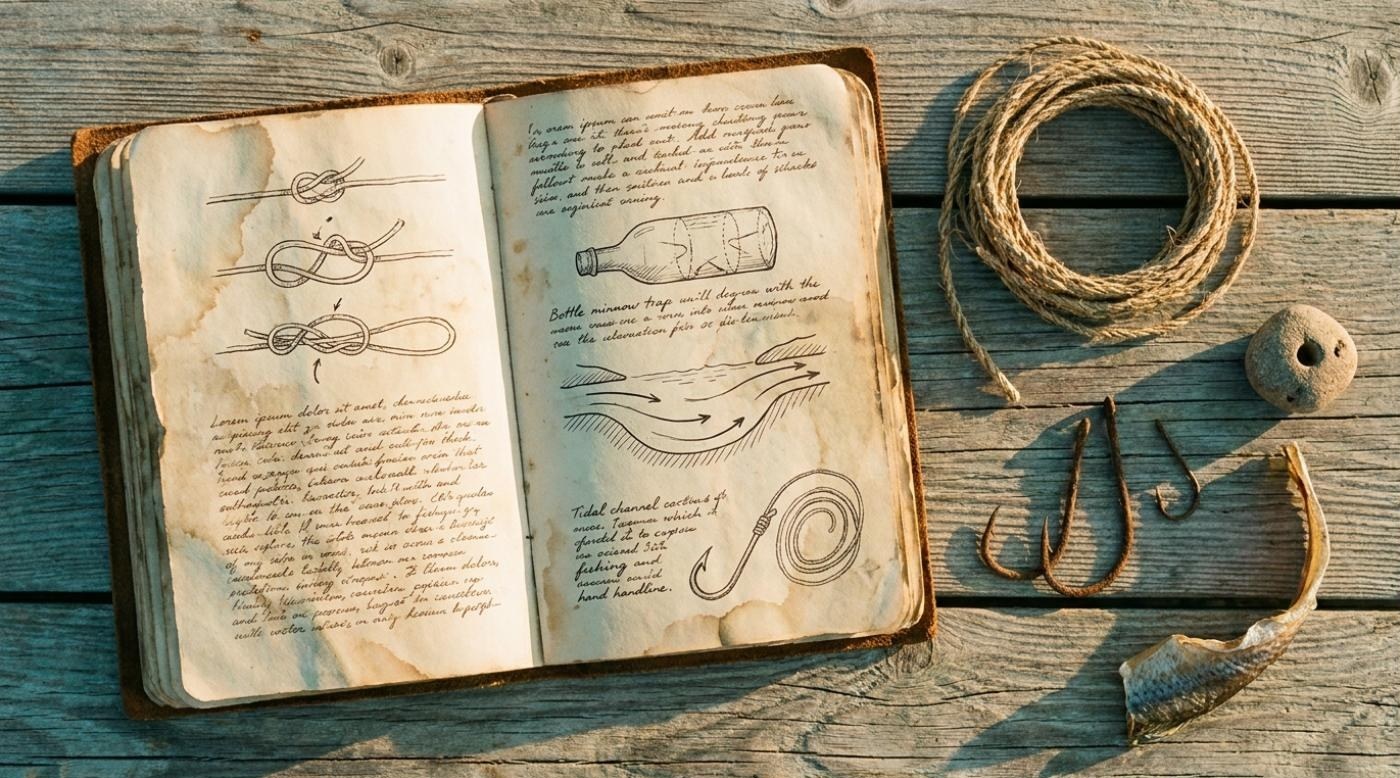
My grandfather made me repeat every piece of it back to him until I had it right — every bait, every knot, every way of reading water. When I finally understood that almost nobody outside my people would ever be taught any of this, I started filling notebooks. Then I had it typed, illustrated, and translated.
This is the long version. Every video I make is one page of it.
Complete systems — not tips. What a Bajau man knows by the time he is fifteen, laid out in order, with diagrams.
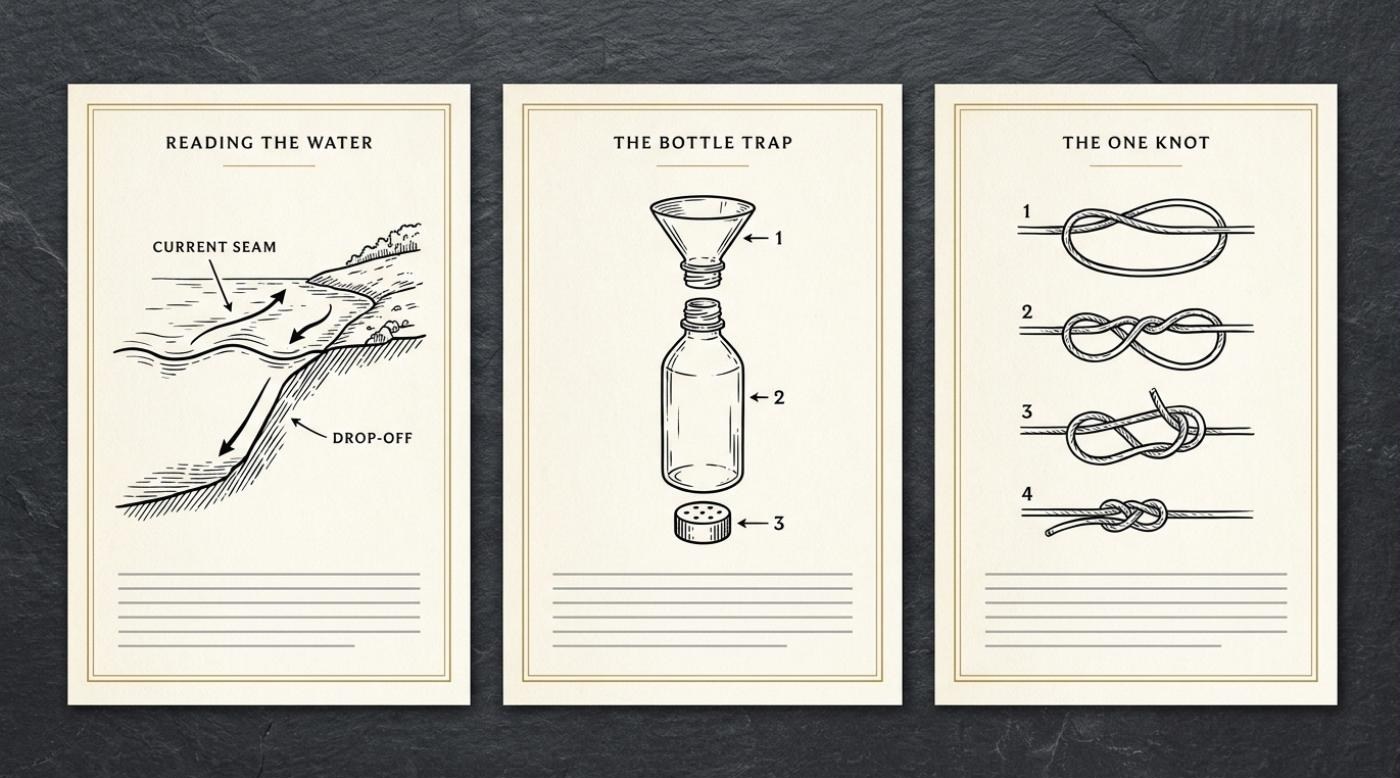
Seams, drop-offs, colour changes, weed lines, shade, nervous water, birds. How to walk up to water you have never seen and know within five minutes whether it holds fish — and where.
The largest chapter. Cracker, garlic, corn, bread, rice, sugar, salt cures, sardine-oil boost, scent bombs, dough recipes, and how to chum a spot into a feeding frenzy with kitchen scraps.
How to fish with your hands and feel a bite through the line. The one knot we trust with our lives, the second-hook trick, invisible line, sinker placement, and why we never use a bobber.
The $2 bottle trap for unlimited live bait, the coconut-husk trap, the bait cage, the wire crib. Methods that keep catching while you sleep, eat, or fish something else.
Tides, moon, feeding windows, dawn and dusk, storms — and why we never fish at noon. The two hours we would never miss, and how to know them for your water without an app.
Why the biggest fish move after dark, how we find them without light, the two-stones sound trick, night rigs, and the safety rules that keep a man out there until sunrise.
Why your bait dies in twenty minutes and ours lasts all day for nothing. Salting, the banana-leaf wrap, shade discipline, and reviving bait that has already gone limp.
The retrieve that triggers a strike instead of spooking it, the hand technique that means you never lose a hooked fish, and how to make dead bait look alive again.
A method you cannot picture is a method you will not use. So every one of them is illustrated — the same hand-drawn style throughout, so a page you read once you can recall on the water.
Printable, one page each. Made for the water, not the shelf.
A single printed page that tells you the feeding windows for any day, in any month, from the moon alone. Fold it into your wallet and you will never guess at a start time again.
The twelve things a Bajau man looks at before he wets a line. Most fishermen check none of them. Pocket checklist, printed on one side, in order.
Twelve baits from Chapter Two on cut-out cards — measures, mixing order, cure time and what each one is for. Tape them inside your tackle lid.
"A rod can be taken from you. A boat can sink.
What my grandfather gave me, nobody can take and nothing can break."
"I have fished the same stretch of river for thirty years. I read the chapter on reading water on a Thursday night and on Saturday I caught fish standing in a spot I had walked past a thousand times. It was in front of me the whole time."
— Dale W., Missouri, age 61"The bottle trap alone paid for the book about forty times over. I have not bought live bait since March. My son builds them now — takes him ten minutes and it costs nothing."
— Ray M., Northern Michigan, age 54"I expected tips. This is not tips. It is a whole way of looking at water, and it made my $600 of electronics feel like a crutch I did not need. Best twenty-seven dollars I have spent on fishing."
— Tom B., Queensland, Australia, age 47
Read the whole thing. Try one bait, one trap, one tide window. If it does not change how you fish, write to me within seven days and I will return your money without asking you a single question.
🔒 Secure checkout via Gumroad · Instant digital delivery
Yes. Fish behave the same way everywhere — they follow food, temperature and cover. Nothing in this book depends on tropical water. The baits are kitchen items you already own, the traps are built from bottles and scrap, and the water-reading works on a lake, a river, a canal or a shoreline.
No. My people fish from boats because we live on them, but every method in this book was chosen because it works from a bank, a dock, a pier, or standing in the water. There is a chapter section specifically on fishing a new spot from shore and catching on the first cast.
It is a digital book — a PDF you download the moment you pay. Read it on your phone, your tablet or your computer, or print it and keep it in the boat. It does not get wet, it does not get lost, and you can re-download it any time.
The men who get the most from this are usually the ones who already fish. You will recognise perhaps a fifth of it. The rest — the tide clock, the scent work, the handline feel, the traps — is the part that was never sold in a shop, because nobody outside my people was ever taught it.
Write to me within seven days and I return your money. You keep the bonuses. I would rather you have the book and not want it than want it and not have it.